
Issue #10 | March 21, 2026

The Numbers
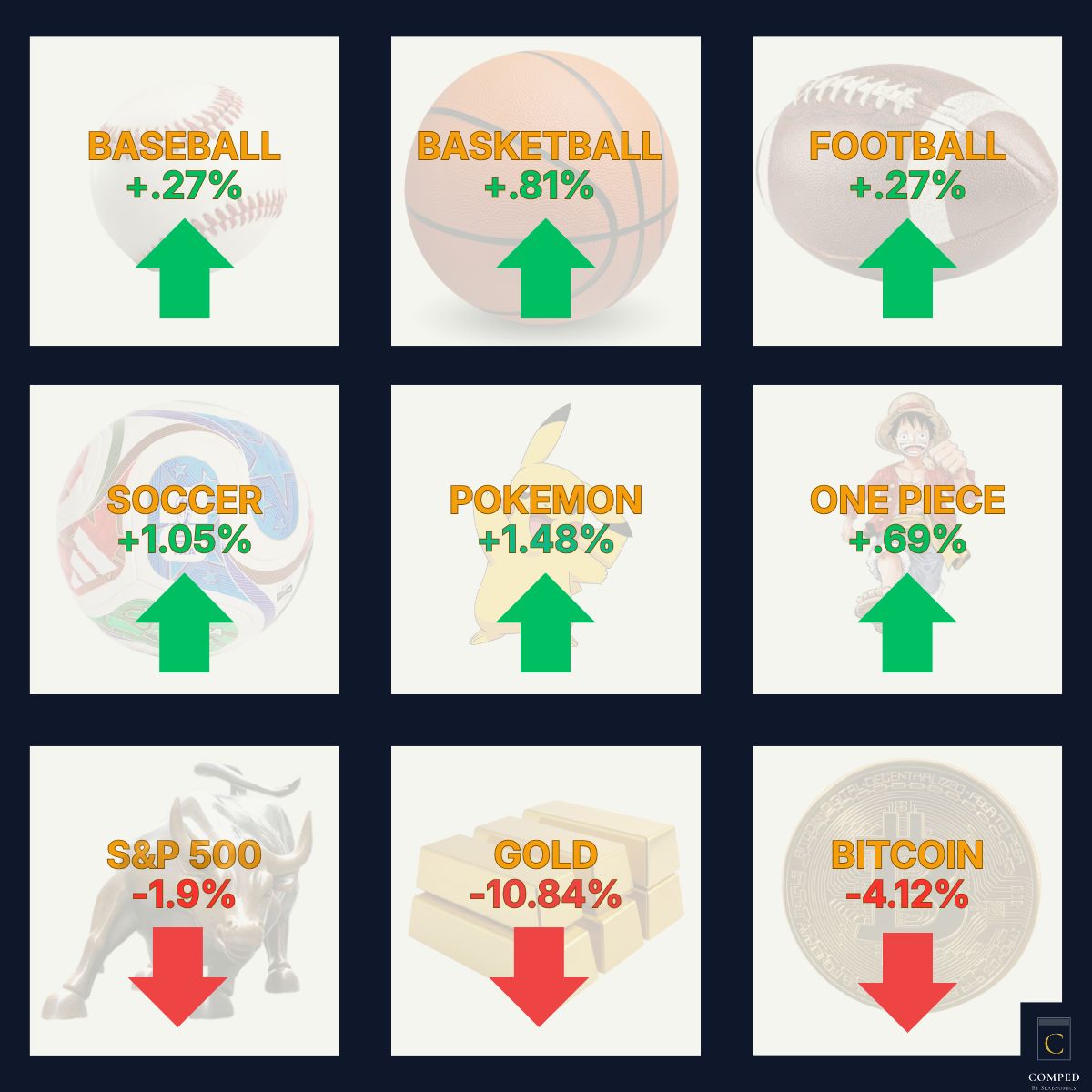
This week the data shows:
–Baseball flat
–Basketball a solid 3-week uptrend
–Football listless in Seattle (and, um, other places)
–Soccer oh, hey World Cup in 81 days
–Pokemon I thought there was a level cap, guess not (up 10 straight weeks)
–One Piece nice gains
–S&P 500 printing press pain👇
–Gold negative trend extends to 3 weeks with an exclamation point👇
–Bitcoin back to its volatile ways
“Hi, my name is S&P 500 and I’m an addict.”
The stock market’s addiction to free money started after the Great Recession when quantitative easing (QE) began. Well, to be honest, the Fed’s real main purpose is and has been QE for a long time, the market just didn’t think this could be expanded to the housing market.
***Disclaimer: This is somewhat technical monetary policy stuff. If bored, just skip this section***
But I digress. I bring this up because how the S&P 500 rises and falls is dictated directly by one thing ever since: Interest Rates. If the Fed is hawkish, they project a monetary policy with increasing interest rates, and when they are dovish, the interest rates are set to fall.
Recently, the Fed moved guidance from 2 interest rate cuts to 1 this year, and the stock market is throwing a fit…Does this matter to cards?
Directly, no.
Indirectly, yes.
This move urges caution.
Now, you may think that gold plummeting tells us the opposite, because gold is a “safe haven” asset (where people park money when they’re worried). But I see this as not gold rising, but the US dollar rising, and gold correspondingly sinking.
When the US dollar rises, hard asset markets like fine art and precious metals correspondingly fall. Cards are at risk here as well, because if dollar rises too much the assets fall and ignite big selloffs (kind of like a bank run).
Imagine if EVERYBODY started selling all their cards on Ebay at the same exact time.
Instead of people comping the last sale or higher, they’d be taking whatever they could get.
The market would be in freefall.
I’ll be keeping an eye on this, no cause for concern yet. Just putting it in your radar.
The News
I went long on the numbers section, so we’ll keep this short.
The biggest news is that we are 81 days away from the World Cup. Now before you roll your eyes and tune out because it’s not your market, don’t be the guy the tide leaves high and dry because you couldn’t take three minutes to read.
Speaking of a tide, I’ve podcasted about demand being similar to one. It moves predictably yet erratically. Demand rushes in quickly to certain spots, then almost before you can react it retracts somewhere else and leaves nothing but sand dollars in its hasty retreat.
Cards are like that. If you’ve ever found yourself telling anyone that would listen: “this card is significantly undervalued; people just don’t understand X,” you get what I’m saying. You can be saying that for years, and all of a sudden someone makes one post on socials and the whole market for that card/parallel/case hit zooms 3x in days.
For 13 months I’ve been researching and talking about the World Cup. I touched on how the last World Cup in the US was in 1994. How there were 0 soccer stadiums then, and the MLS has 30 now. How there were no notable players in America, and now the greatest player that’s ever lived is twilighting his career here for a team owned by David Beckham.
How FIFA projects $41 Billion in GDP impact for host cities.
The marketing machine is now turning on. Values are already accelerating. The energy that this event will bring cannot be overstated.
Fight the tide or swim with it, but you’re going to get wet.
The Framework

Prices for rookies is crazy, right? I mean, how quantifiably crazy though?!?
That was the purpose of this deep dive project that I posted on Instagram yesterday…And I was not prepared for the results.
Without spoiling the next installment covering Modern (1996-2017) I can tell you the value difference for silvers and refractors from rookie to 2nd year is a CLIFF.
The average loss from rookie gem market cap (value of all PSA 10s taken together) is 98%.
And this wasn’t even taking scrubs with the studs, this was THE most valuable superstars of this era.
By the time you get to year 3 many times your barely holding on to 4 digit values.
What’s happened is a widening of the sports card markets. There are too many parallels competing for investor dollars in this day and age. Compounding this, the flipping frenzy that replaced the more slow-moving collectors’ completionism means that value doesn’t rise because demand just moves on.
There is no way people are collecting silvers and refractors of modern players when both SGA and Justin Herbert’s 3rd year silver gem market caps are under $350. That means with $700 you could buy all the PSA 10 Prizm Silvers for their 3rd year cards in existence (at fair market value).
So, we know what is going on and we know why, but we don’t know IF and when that might change. This is always a critical consideration, because as Big Short fans know, the market can stay irrational longer than you can stay solvent.
But the true question is, will there come a time when the market will wake up, and all the demand for these plum blossom, orange wave, blue octopus etc. parallels will consolidate into the true color parallels?
What really makes a true color parallel worth long term investment?
I can’t be sure, as we’re knee deep in the junk parallel era, but I can say that humans consolidate into what is safe and known when uncertainty arises. That’s why vintage always grows and acts as a net that always catches new investment in good markets and bad.
For my two cents, when we see real uncertainty arise, I think money flows out of junk parallels and players into silvers and golds of legends. ❝
“Only when the tide goes out do you see who’s been swimming naked” -Warren Buffett
Keep Building,

DISCLAIMER: This newsletter is for educational and informational purposes only and does not constitute financial, investment, or legal advice. The content reflects the author's personal opinions and analysis and should not be construed as a recommendation to buy, sell, or hold any assets. Sports cards and collectibles are speculative investments with significant risk of loss. Past performance is not indicative of future results. The author may hold positions in assets discussed in this newsletter. Readers should conduct their own research and consult with qualified financial, tax, and legal professionals before making any investment decisions. By reading this newsletter, you acknowledge and accept these terms.
Update your email preferences or